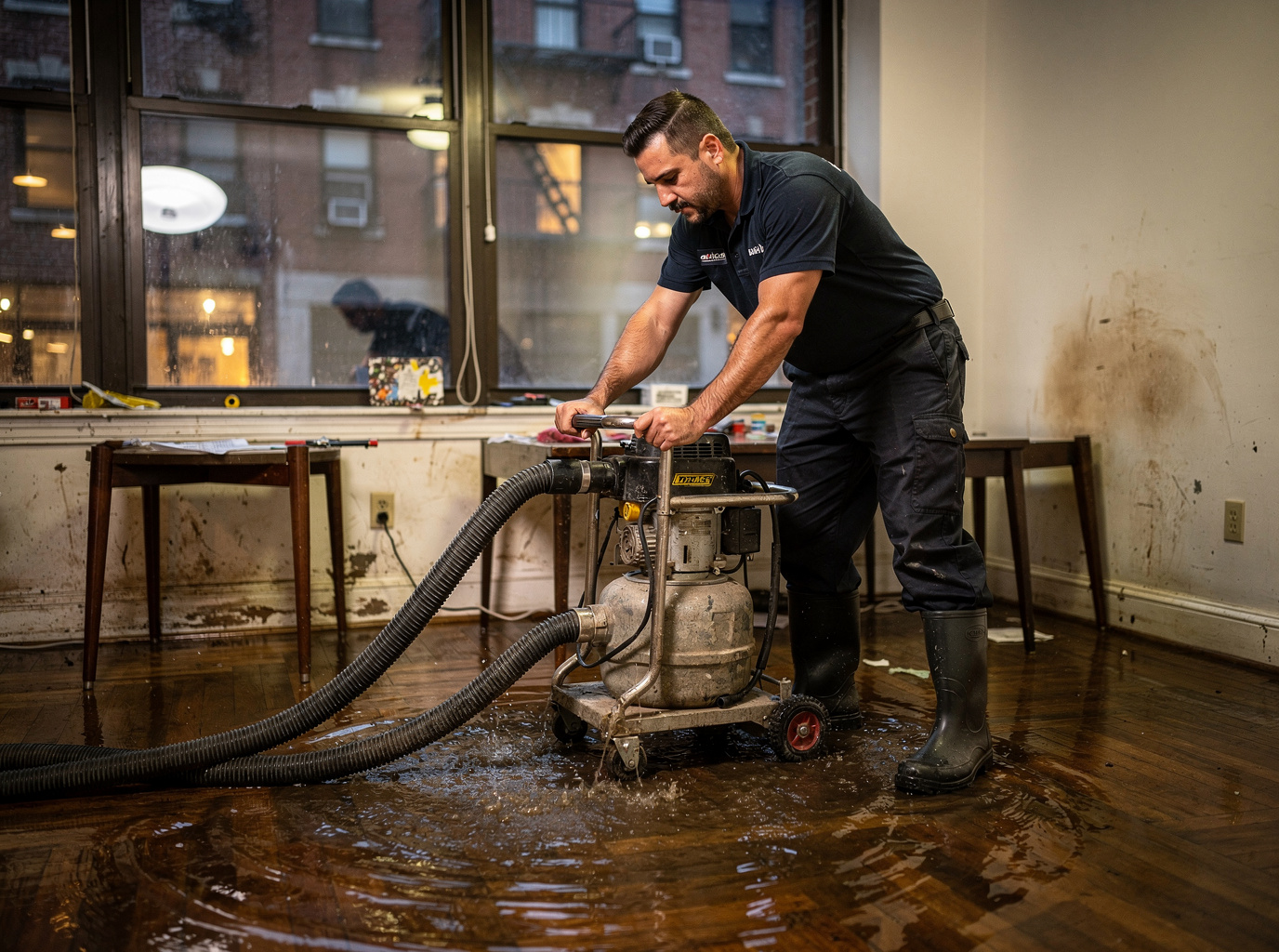
In New York County, pre-war apartments and brownstones along the Upper East Side often feature aging cast-iron pipes and flat roofs that fail during heavy summer rains or winter freezes. Emergency water removal here requires immediate subfloor extraction because moisture trapped under wide-plank flooring quickly migrates into shared walls and neighboring units. Crews must navigate narrow service elevators and tight basement mechanical rooms while monitoring humidity levels that stay elevated even after extraction due to the subtropical climate.
Central Park South high-rises and Times Square commercial spaces present different constraints: concrete slabs and limited drainage points mean water can pool for days before reaching lower levels. Technicians use truck-mounted extractors and air movers positioned on loading docks to avoid disrupting pedestrian traffic near the Empire State Building. Winter jobs frequently involve thawing frozen lines first, then extracting meltwater that has already saturated insulation behind brick facades.
Brooklyn row houses near the business location at 4904 Avenue L face sewage backups after intense storms because combined sewer systems overflow. Extraction teams isolate affected areas quickly to prevent cross-contamination into adjacent properties common in these dense blocks. Drying protocols account for the cold winters that slow evaporation and the humid summers that encourage mold within 48 hours if moisture remains.
Bronx multi-family buildings add another layer with their mix of slab-on-grade and raised basements; water from roof leaks travels through multiple floors before detection. Portable moisture meters guide targeted removal to avoid unnecessary demolition in occupied units while meeting New York City building code requirements for ventilation during drying.
Technician insight
In New York the thing that catches most people out with Emergency Water Removal is how quickly moisture travels through shared plaster walls in pre-war buildings once it hits the subfloor; a leak on the Upper East Side can affect three units before anyone notices because the cold winters keep humidity trapped and the humid summers accelerate mold.
Upper East Side Brownstone Pipe Failure
A frozen supply line burst on the third floor of a 1920s building near Central Park. Water migrated down through two floors and into the neighbor’s unit. Extraction crews isolated the affected walls, removed standing water from the basement, and ran drying equipment for four days until moisture readings normalized.
Emergency Water Removal Services We Offer
✓Burst Pipe Water Extraction
Immediate removal of water from failed supply lines in Manhattan pre-war buildings before it reaches neighboring apartments.
✓Flooded Basement Extraction
Submersible pump and truck extraction for storm or sewer water in Brooklyn row-house basements with limited egress.
✓Roof Leak Water Removal
Targeted extraction from flat-roof failures common on Upper East Side brownstones during summer downpours.
✓Appliance Leak Extraction
Rapid cleanup of washing machine or water heater failures in tight Bronx utility rooms to limit floor damage.
✓Sewage Backup Cleanup
Contaminated water removal and isolation in combined sewer areas near Times Square and Central Park.
Emergency Water Removal Cost in New York, NY
| Service | Typical Range | What Affects It |
|---|---|---|
| Single-room extraction | $350–$650 | Higher when water reaches subfloor in pre-war apartments |
| Basement extraction | $800–$1,800 | Increases with sewage contamination or multiple pumps needed |
| Multi-floor water removal | $1,200–$2,500 | Driven by stair access and shared-wall migration in row houses |
| Emergency after-hours response | $200–$400 premium | Applies outside Mon–Fri 8am–6pm and Sat 9am–2pm |
Ranges are typical for New York, NY and confirmed with an exact written quote before any work starts.
How it works
- 1
Arrival And Safety Assessment
Technicians arrive from the Brooklyn base, evaluate structural access, and shut off water sources while checking for electrical hazards in older New York wiring.
- 2
Water Extraction
Truck-mounted and portable pumps remove standing water from basements, subfloors, and wall cavities common in Manhattan and Brooklyn stock.
- 3
Moisture Mapping
Infrared and meter readings identify hidden saturation behind brick and plaster in pre-war buildings before drying begins.
- 4
Drying And Monitoring
Air movers and dehumidifiers run until readings drop, with daily checks accounting for humid summers and cold winter slowdowns.
Pricing
Costs depend on volume of water, number of affected floors, and access limitations typical in older New York buildings.