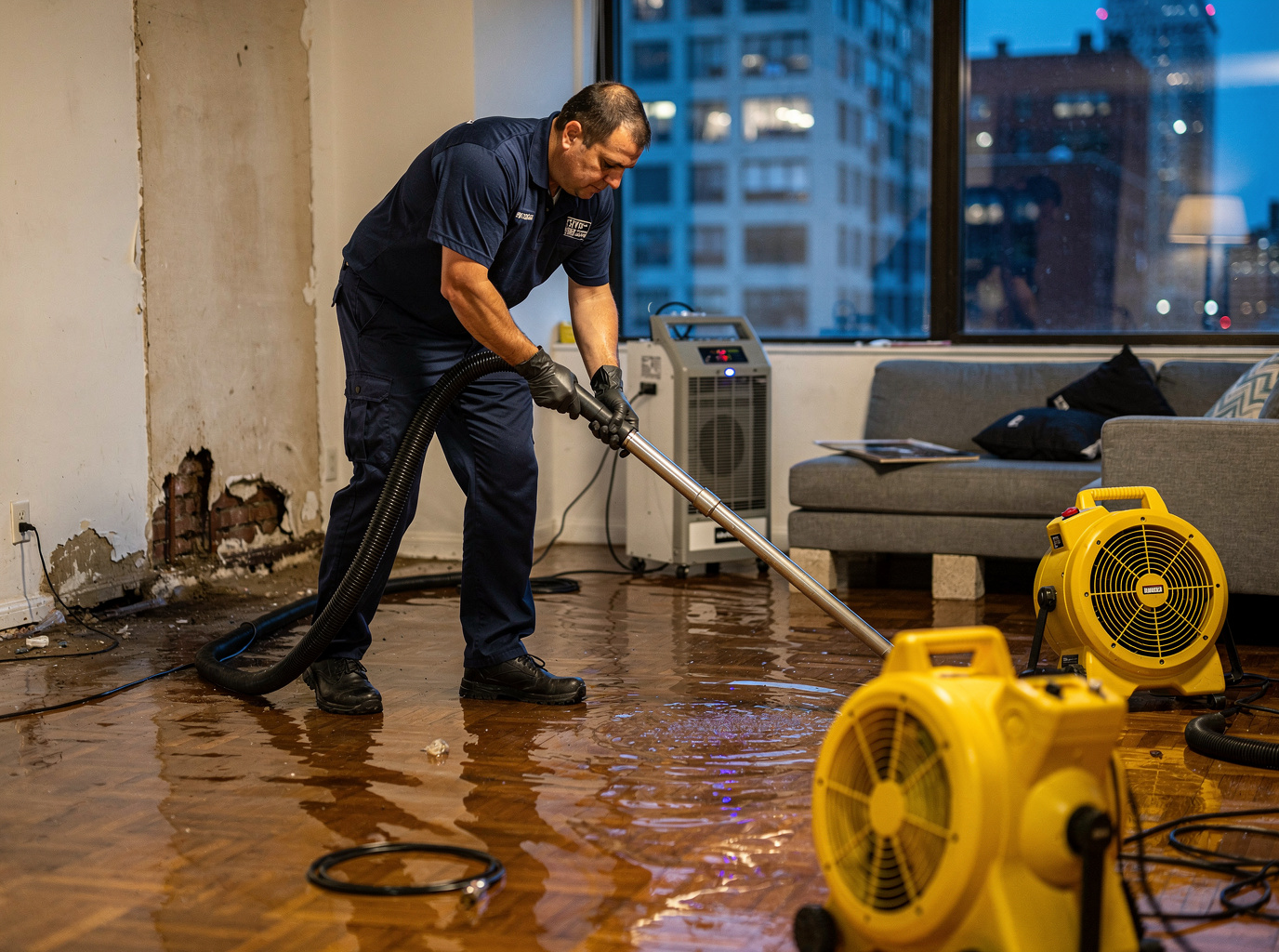
New York County properties, especially pre-war apartments along the Upper East Side near Central Park, often feature plaster-over-lath walls and cast-iron pipes that fail without obvious surface signs. When a leak starts behind these materials, water travels horizontally through floor joists and into neighboring units before residents notice pooling. Our crews map moisture with thermal imaging because visual inspection alone misses hidden saturation in Empire State Building-era masonry that retains humidity long after the source is stopped.
Hot humid summers accelerate mold growth on saturated wood lath within 48 hours, while winter freezes burst exposed pipes in unheated basements common in Bronx row houses. Extraction must account for the county’s clay-heavy soil that slows natural drainage around building foundations, pushing groundwater back through cracks during heavy rain. We stage industrial dehumidifiers in tight stairwells because high-rises limit airflow and standard fans cannot reach interstitial spaces between floors.
Times Square commercial spaces and Brooklyn brownstones share the same challenge: mixed materials where modern drywall meets original tin ceilings. Removing water without damaging historic finishes requires controlled demolition cuts that preserve ornamental plaster. After extraction we document every layer dried so insurance adjusters see the full scope before reconstruction begins.
Technician insight
In New York, the thing that catches most people out with Emergency Water Damage Restoration is how quickly water travels horizontally through the floor joists of pre-war buildings on the Upper East Side; a small ceiling leak on the fourth floor can saturate three units below before anyone sees a stain because the plaster-and-lath system hides the path.
Upper East Side Apartment Ceiling Leak
Water from a fifth-floor bathroom seeped through joists into a fourth-floor unit near Central Park. We found saturated plaster extending two rooms beyond the visible stain. Extraction and targeted drying prevented mold growth during the humid summer; the owner resumed occupancy within five days.
Emergency Water Damage Restoration Services We Offer
✓Flood Water Extraction
Removes standing water from basements and ground-floor units in Manhattan and Upper East Side buildings where gravity drainage is limited by surrounding grade.
✓Pipe Burst Restoration
Isolates and dries water from frozen or corroded supply lines common in pre-war New York County apartments before mold sets in during humid summer months.
✓Ceiling Leak Repair
Addresses water migrating from upper floors through joist bays in multi-story buildings near Central Park and Times Square without unnecessary demolition of finished surfaces.
✓Structural Drying
Uses targeted air movers and dehumidifiers to pull moisture from brick, plaster, and hardwood in older stock where standard residential equipment cannot reach interstitial cavities.
✓Basement Water Mitigation
Handles groundwater intrusion through foundation walls in Brooklyn and Bronx properties where clay soil and high water table keep moisture levels elevated after storms.
Emergency Water Damage Restoration Cost in New York, NY
| Service | Typical Range | What Affects It |
|---|---|---|
| Initial Assessment | $150–$300 | Higher in multi-story Manhattan buildings with limited access |
| Water Extraction | $400–$900 | Varies with volume and whether sewage is present |
| Structural Drying (per room) | $250–$600 | Increases with plaster and hardwood in older Upper East Side units |
| Emergency After-Hours Response | $200–$450 | Added when work starts outside Mon–Fri 8am–6pm or Sat 9am–2pm |
Ranges are typical for New York, NY and confirmed with an exact written quote before any work starts.
How it works
- 1
On-Site Assessment
Technicians arrive within hours, document visible water paths, and use moisture meters on walls and floors in the affected Manhattan or Upper East Side unit.
- 2
Water Extraction
Submersible pumps and wands remove standing water while protecting adjacent units from cross-contamination common in dense New York County buildings.
- 3
Drying and Monitoring
Equipment runs continuously with daily readings until materials return to acceptable moisture levels, accounting for summer humidity that slows evaporation.
- 4
Final Documentation
Photos and meter logs are compiled for the property owner and any insurance claim before reconstruction planning begins.
Pricing
Upfront quotes given after inspection; final cost depends on water volume, materials affected, and number of floors involved.